🎲 Paper Dice & Polyhedra Nets
Printable nets for dice and 3D shapes — numbers, pips or your own words on the faces, glue tabs placed for you, and a preview that folds it up.
1 · Shape
2 · Size
3 · Faces
Ideas: chores, story starters, dinner choices, maths facts, emoji.
4 · Print
How to make it
- Print on card (160–250 gsm works best) at Actual size / 100%.
- Cut around the outside, including the glue tabs.
- Score every fold line with a blunt knife or an empty ballpoint along a ruler, then fold away from you so the print ends up on the outside.
- Glue the tabs one at a time, tucking each one inside the neighbouring face. Close the last face with tweezers or a pencil pushed in from a gap.
Dice nets at a glance
| Die | Shape | Faces | Opposite faces add to |
|---|---|---|---|
| d4 | Tetrahedron | 4 triangles | — (read the top point) |
| d6 | Cube | 6 squares | 7 |
| d8 | Octahedron | 8 triangles | 9 |
| d10 | Pentagonal trapezohedron | 10 kites | 9 (numbered 0–9) |
| d12 | Dodecahedron | 12 pentagons | 13 |
| d20 | Icosahedron | 20 triangles | 21 |
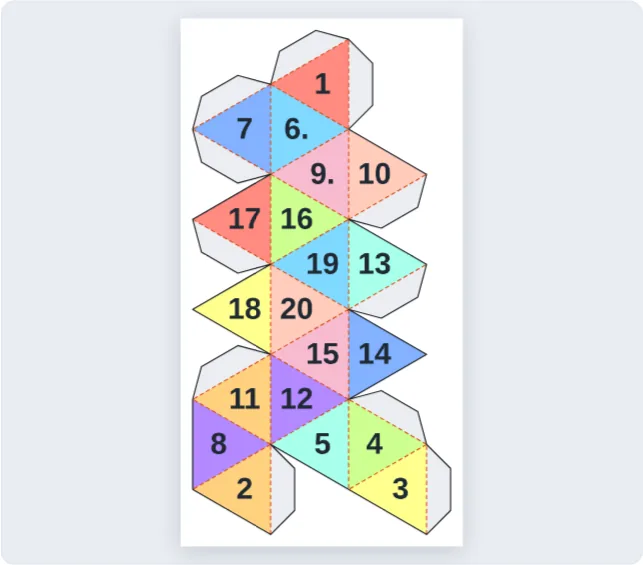
Paper dice for games and classrooms
Print a full role-playing dice set on card, or type your own words on the faces for story cubes, chore dice, maths-fact dice or a dinner decider. The pyramids and prisms make ready-to-fold models for geometry lessons — the nets are calculated from the real 3D shape, so every one closes. Choose the edge length to set the finished size: a 30 mm edge makes a 3 cm cube, or a d20 about 5.7 cm from point to point.
About the Polyhedra Net Maker
🎲 A full dice set
d4, d6, d8, d10, d12 and d20 for tabletop games, with opposite faces adding up the way real dice do — 1 is opposite 6 on the cube, 1 opposite 20 on the d20.
🔺 Shapes for maths
Pyramids, prisms and the cuboctahedron for geometry lessons — the nets are worked out from the real 3D shape, so they always close.
✍️ Your own faces
Type a word list to make story cubes, chore dice, decision makers or maths dice. Emoji work too.
🧩 Tabs that fit
Every open edge gets exactly one glue tab, sized and angled so no tab runs into another face on the sheet.
🧊 Watch it fold
The 3D preview folds the printed net into the finished shape, with your numbers and colours on it.
✂️ Cricut-ready
Download an SVG with cut and score lines on separate layers, in real millimetres.
Frequently Asked Questions
What paper should I use for paper dice?
Thin card around 160–250 gsm (60–90 lb cover) is ideal: stiff enough to hold the shape and still easy to score and fold. Ordinary printer paper works for practice models.
Will a paper d20 roll fairly?
A carefully folded paper die is close enough for casual games. Fold crisply along scored lines and glue the tabs flat so every face is the same size.
How are the numbers arranged?
Like real dice, opposite faces add up to one more than the number of faces: 7 on a d6, 9 on a d8, 13 on a d12 and 21 on a d20. The d10 is numbered 0–9 with opposite faces adding to 9. The d4 has three numbers on each face — read the one at the top point.
How big will the finished shape be?
The edge length sets the size. A cube with 30 mm edges is a 3 cm die; a d20 with 30 mm edges is about 5.7 cm from point to point. The summary under the preview shows the flat net size and the pages it needs.
Which way do I fold?
Fold every line away from you, so the printed side is on the outside. The glue tabs tuck inside the shape.
How do you make a paper d20?
Print the d20 net on card, cut around the outside, score every fold line and fold away from you. Glue the tabs one at a time inside the shape, closing the last face with a pencil pushed in through the gap.
Can I put words or pictures on the faces?
Choose “My own words” and type one word or emoji per line; they go round the faces in order. Ideas: story prompts, exercises, chores, or questions for a class.